Digital restoration
Scauflaire,
at brushstroke range.
Commissioned by the Liège Royal Philharmonic Orchestra for the mural paintings of its hall
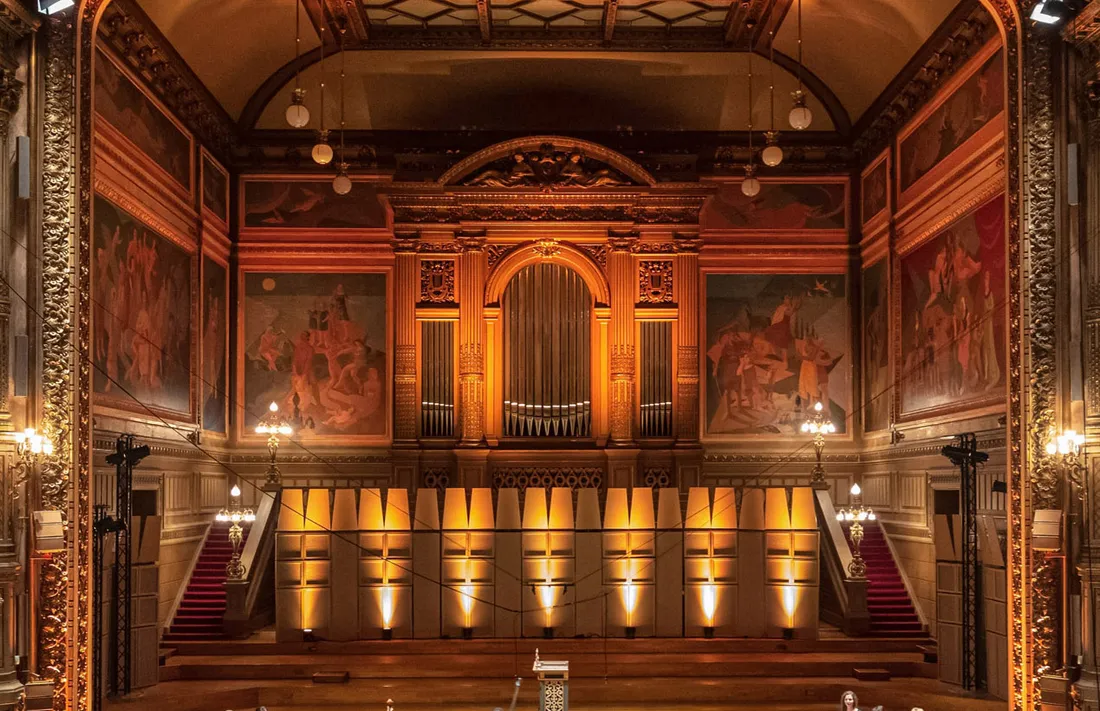
Between 1952 and 1954, the Liège painter Edgar Scauflaire covered the three stage walls of the Liège Philharmonic Hall with sixteen mural paintings inspired by musical themes. From the stalls, the audience guesses at them more than it sees them: they are high, distant, and concert lighting does them no favours.
These are murals, painted in oil directly onto the wall, and they are seventy years old. Time has marked them: networks of craquelure, rings left by damp, chips knocked out of the paint layer and, here and there, losses — areas where the drawing had simply gone.
In 2023 the Liège Royal Philharmonic Orchestra commissioned me to restore the eight principal panels digitally. I photographed them in high definition — close to two hundred exposures, assembled one by one — then spent a month redrawing what time had taken away. The aim is not to show the current state of the walls, but to give the paintings back the face Scauflaire gave them.
Sixteen panels for three stage walls
Since the inauguration of the Philharmonic Hall in 1887, the stage walls had offered nothing to the eye but large flat surfaces, soberly framed by gilded mouldings. In the early 1950s, the department of Fine Arts and Public Education commissioned Edgar Scauflaire (1893-1960), a renowned Liège painter, to produce large paintings for these panels that had remained bare.
Scauflaire was already well versed in large formats: pastels, stained glass, painting on glass, theatre curtains. Here he adopted oil paint, assisted by the painters Jean Debattice, José Delhaye and Valère Saive. The work unfolded in two campaigns: the lower panels of the side walls were completed in 1952, the full set of sixteen in 1954.
Symmetry, backgrounds built from juxtaposed fields of colour, a measured cubist influence: these walls extend Scauflaire’s easel painting and offer a fine example of modern art integrated into an older building. Detractors of the day proposed covering them with a uniform whitewash. The protest that followed led to the building being listed on 27 May 1986. The paintings were cleaned between 1998 and 2000, as part of the restoration of the hall.
The painter-poet
Edgar Auguste Philippe Scauflaire was born in Liège on 9 March 1893, the son of a tailor and a seamstress. He attended evening classes at the Royal Academy of Fine Arts in Liège, where Auguste Donnay, Adrien de Witte and François Maréchal taught, and long earned his living as a journalist at La Meuse — signing his art criticism with the pen name Jean Hibou and frequenting the city’s artistic circles, among them La Caque, where the young Georges Simenon passed through. Only from 1936 could he live by his brushes.
His body of work, estimated by some sources at close to six thousand pieces, achieves a rare synthesis of cubism, Art Deco and a dreamlike expressionism inherited from Chagall. Cats, harlequins and the female body recur throughout; landscape never does. Invited to the Venice Biennale from 1924, he exhibited in Paris, Milan, São Paulo, Rio de Janeiro, Helsinki, at the Pushkin Museum in Moscow, and at the 1958 Brussels World’s Fair, where he also sat on the jury.
The decoration of the great hall of the Royal Conservatory of Liège, today the Philharmonic Hall, stands among his last major commissions. Scauflaire died on 22 October 1960. Critics then turned away from his work for more than thirty years, until Delphine Quirin devoted her thesis to him in 1993 and a retrospective was held in Liège in 1994. Evelyne de Quatrebarbes, and then Quirin, gave him the name that stuck: the painter-poet.
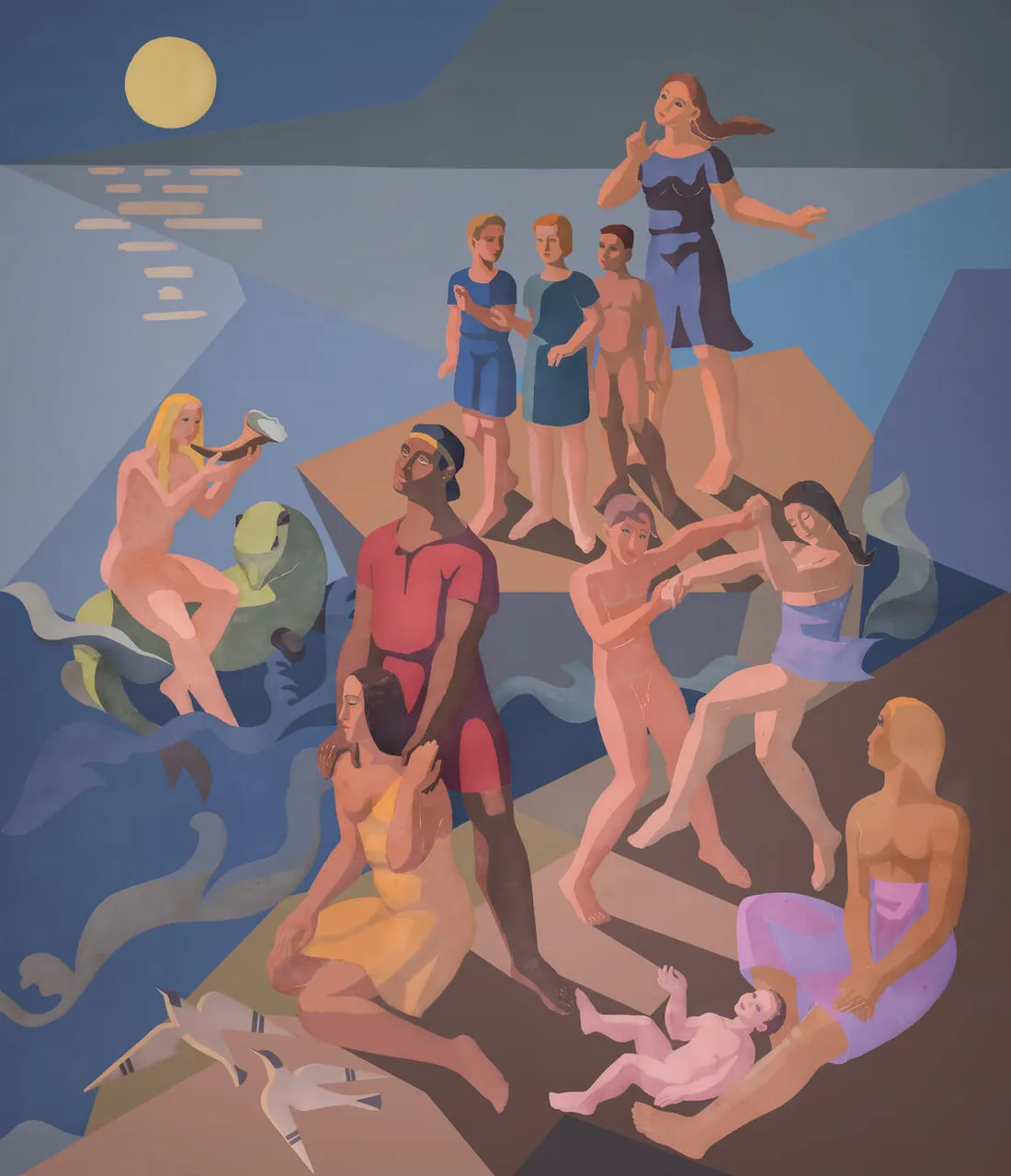
The Birth of Music
To the left of the organ, Scauflaire imagines the first appearance of music. A young girl perched on a sea creature, an imaginary animal recalling prehistoric times, blows into a conch shell; to its sound, a couple sketches a few dance steps.
The painter sides here with Plato: dance and music appeared together and remain inseparable.
The Myth of Orpheus
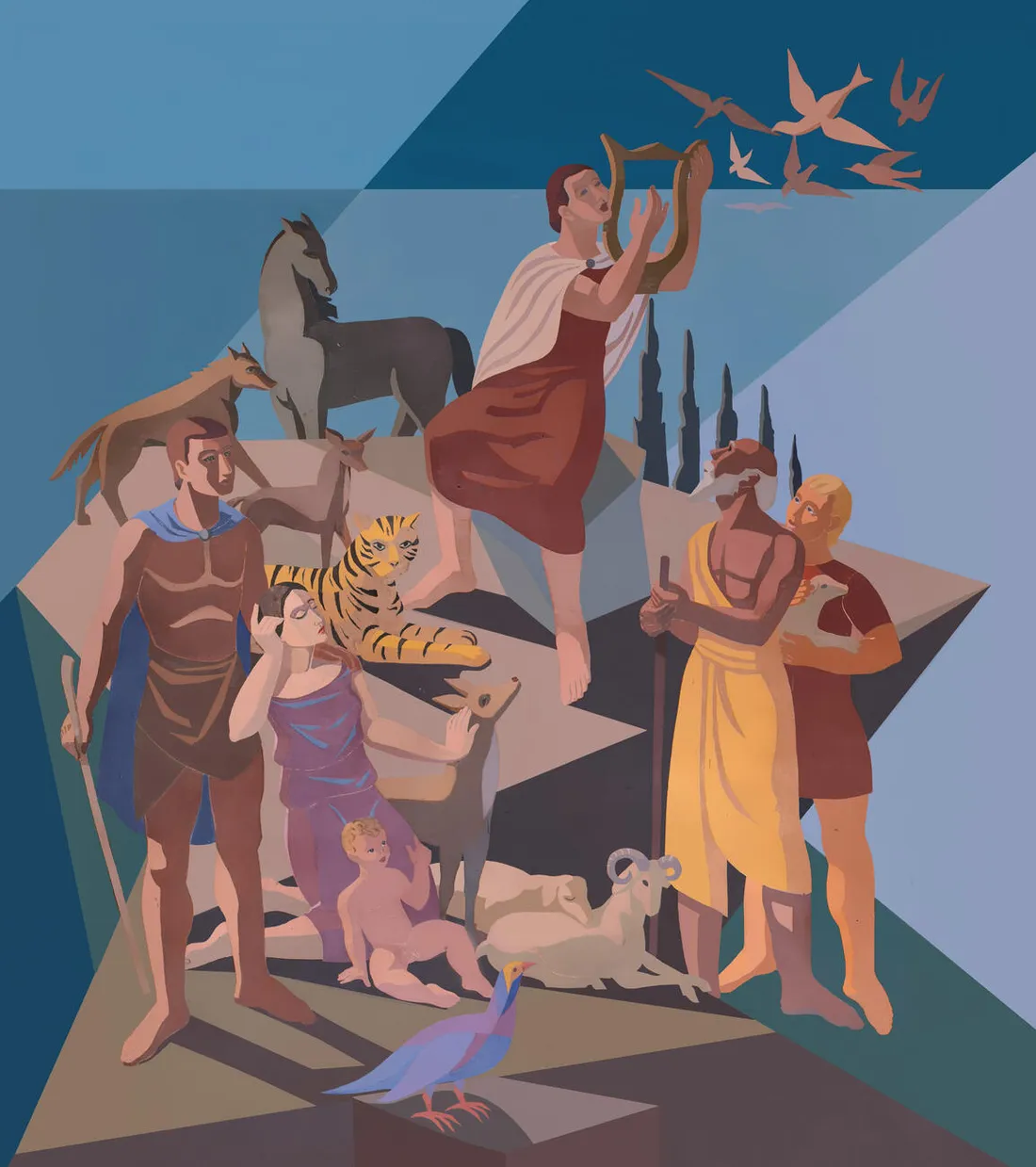
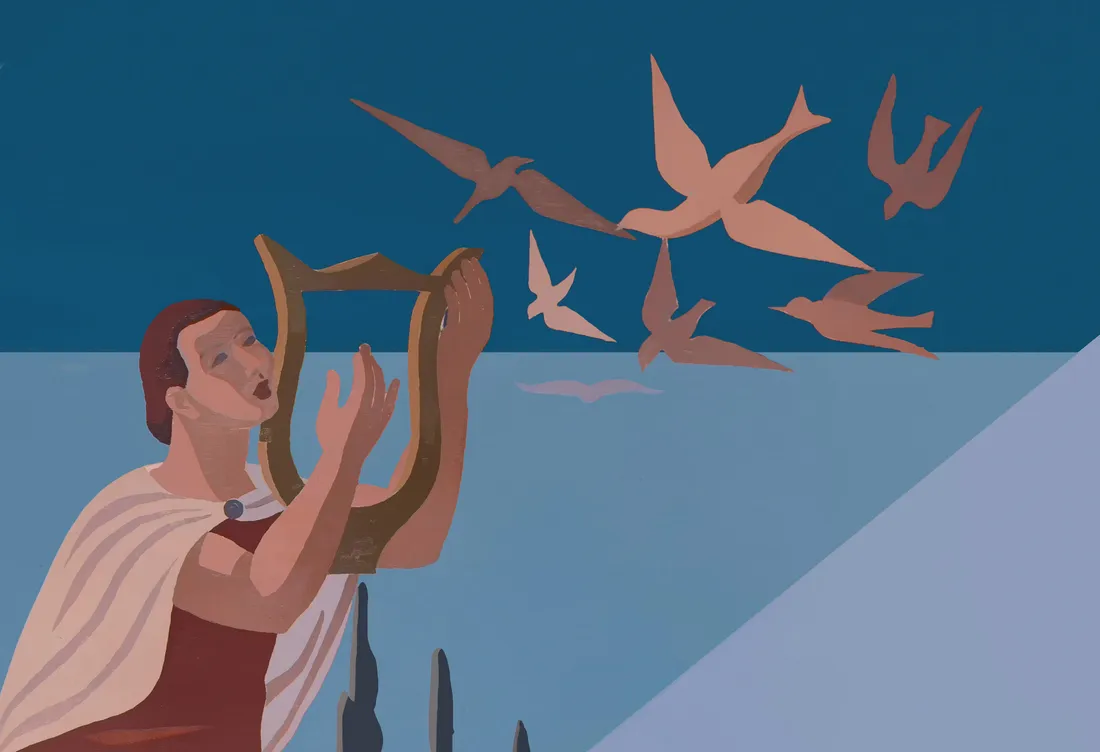
On the opposite wall, Orpheus charms humans, animals, plants and minerals with his lyre. The myth, inherited from Antiquity and revived across the centuries — notably during the Florentine Renaissance through the philosopher Marsilio Ficino — speaks of the power of music over living beings and over the rest of creation.
A detail of this panel, reproduced further down, shows what high definition makes possible: the wood of the lyre, the flight of the birds and the weave of the brushwork, at a scale no listener can reach from their seat.
Homage to André-Modeste Grétry
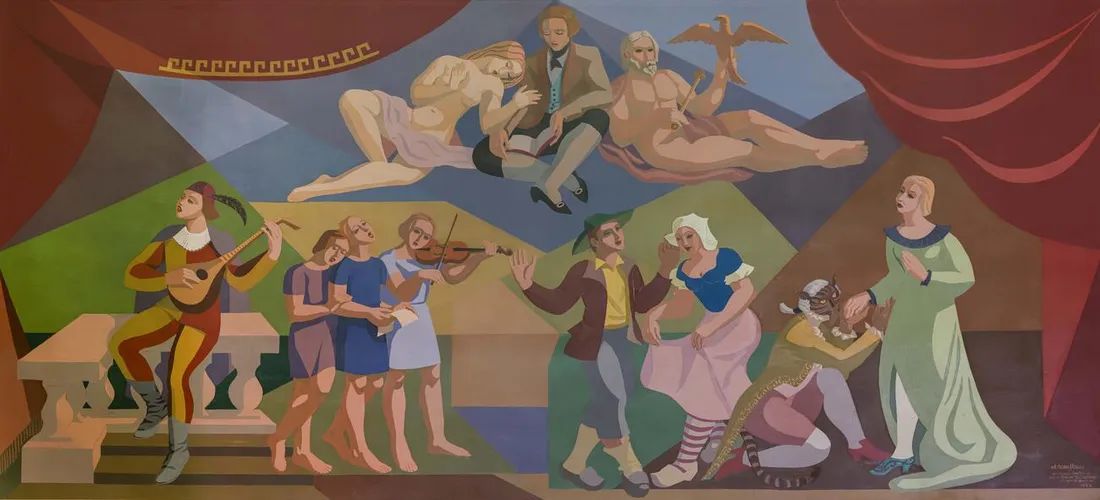
Leaving mythology behind, Scauflaire devotes the side walls to two illustrious Liège composers. On the right, André-Ernest-Modeste Grétry (1741-1813) appears in apotheosis. He holds a book rather than a score, a probable allusion to the fact that he was also a writer. A nude young woman, perhaps the inspiring muse, and an older man bearing a sceptre and an eagle flank him: Grétry was valued under the Ancien Régime as much as under the Empire.
Below them crowd scenes drawn from his works. On the right, a cat-headed man bows before a young girl: Zémire et Azor, a comic opera inspired by Jeanne-Marie Leprince de Beaumont’s Beauty and the Beast. Beside them, villagers dance, an echo of the Six nouvelles romances. On the left, the troubadour may point to Richard Cœur de Lion. Two side panels complete the ensemble — a harpist and a man seated on a drum playing a conical-bore instrument — both in eighteenth-century dress.
Homage to César Franck
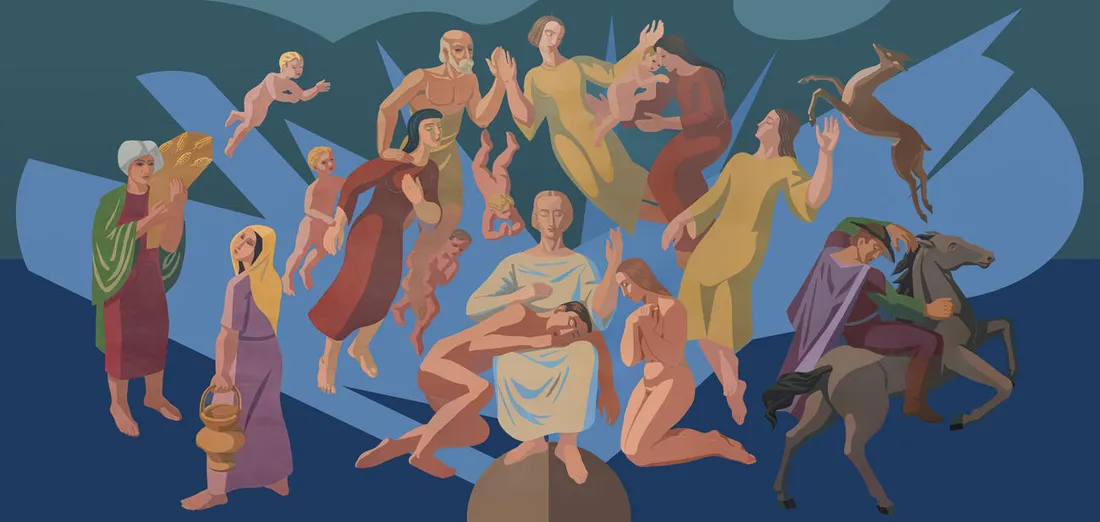
On the left, César Franck (1822-1890) is framed by two panels decorated with women musicians. The central scene gathers only figures drawn from his works. At its heart, Les Béatitudes: Christ as love, above a terrestrial globe, calms the sorrows of humanity with a gesture; the figures in the background are perhaps the blessed.
On the left, two women evoke the oratorios Ruth (1846) and Rebecca (1881), drawn from the Old Testament: Ruth carries the ears of wheat gleaned in the fields of Boaz, her future husband, while Rebecca holds out the water jug she offers to the servant sent by Abraham. On the right, the rider and the doe belong to Le Chasseur maudit. The Count of the Rhine forsakes mass for the hunt, defies the pious souls who try to hold him back, then finds himself alone in the forest; his horse refuses to move on and a voice from beyond the grave curses him forever. Scauflaire captures the moment the mount rears.
Two hundred exposures for eight panels
The commission covered the eight principal panels, the ones carrying the large compositions; the upper panels, simply decorated with cherubs, were not part of it. The work began at the back of the hall, with a 135 mm lens and then a 250 mm. Each panel was photographed in sections, piece by piece, rather than in a single overall view.
Close to two hundred exposures were made this way. The method limits the optical distortion that is unavoidable across such large surfaces and, above all, it keeps sharpness consistent from one edge of the panel to the other: the top corner of a painting is as crisp as its centre.
Craquelure, losses, damp
A mural does not age like a canvas: it endures the building that carries it. The support moves, damp migrates, heat rises, audiences pass through. Across Scauflaire’s panels the network of craquelure had spread everywhere; damp had left rings and whitish veils; knocks had taken the paint layer away in small chips. Elsewhere the drawing was simply missing.
The cleaning carried out between 1998 and 2000, as part of the restoration of the hall, did its job. But cleaning does not give back what has gone, and intervening physically on these surfaces, at that height, is a considerable undertaking. The digital route offers another way forward: making the works legible, and showing what ought to be returned to the wall.
Assemble, straighten, redraw
The images were first assembled in Photoshop, meticulously. Distance and shooting angle distort the works: perspective corrections give each panel back its exact proportions.
Then comes the restoration itself, a month of work. Surface blurs calm the network of craquelure without erasing the material. Rings and veils of damp are played down area by area. Where the paint layer had gone, it had to be redrawn: picking up a contour, rebuilding a fold of cloth, a background, a hand, working from the intact parts of the same panel and from Scauflaire’s graphic vocabulary, which is highly recognisable.
Colour demanded the most research: the original palette had to be recovered from under hall lighting that betrays it, then harmonised from one panel to the next. The intention throughout was to make the paintings young again.
A restitution, not a condition record
It is worth saying plainly: these images do not show the walls as they are today. They show the paintings free of their injuries, as Scauflaire left them. A restorer wanting to establish a condition report would need to work from the original exposures, before retouching, or go back to the wall itself.
What these files offer lies elsewhere. They make Scauflaire’s large compositions legible at last, they give access to details no listener can see from their seat, and they sketch out what a physical restoration might aim for. Eight of the sixteen panels have been treated so far, and four of them illustrate the page the Liège Royal Philharmonic Orchestra devotes to Scauflaire’s paintings.
The images on this page are digital restorations: craquelure, damp marks and losses have been played down or redrawn. They restore the appearance of the paintings, not the current state of the walls. The works are by Edgar Scauflaire (1893-1960); the photography, the assembly and the digital restoration are mine. The iconographic reading of the panels follows the notice published by the Liège Royal Philharmonic Orchestra, itself based on Delphine Quirin and Louis Maraite, Edgar Scauflaire (1893-1960), peintre-poète, catalogue of the exhibition held in Liège in 1994. The biographical details follow the painter’s Wikipedia entry.
Edgar Scauflaire’s paintings, on the Liège Royal Philharmonic Orchestra website ↗