More
is more.
Thierry Lechanteur is a Belgian photographer and digital artist based in Liège. After thirty years of graphic design, studio and architecture photography, he has been composing with generative AI since 2022 — for his own projects and for houses of craft — under one principle: “Made, not generated.”
In a world where good taste celebrates restraint and “less is more” as its only horizon, my work affirms another path.
Artist Statement
They were too much.
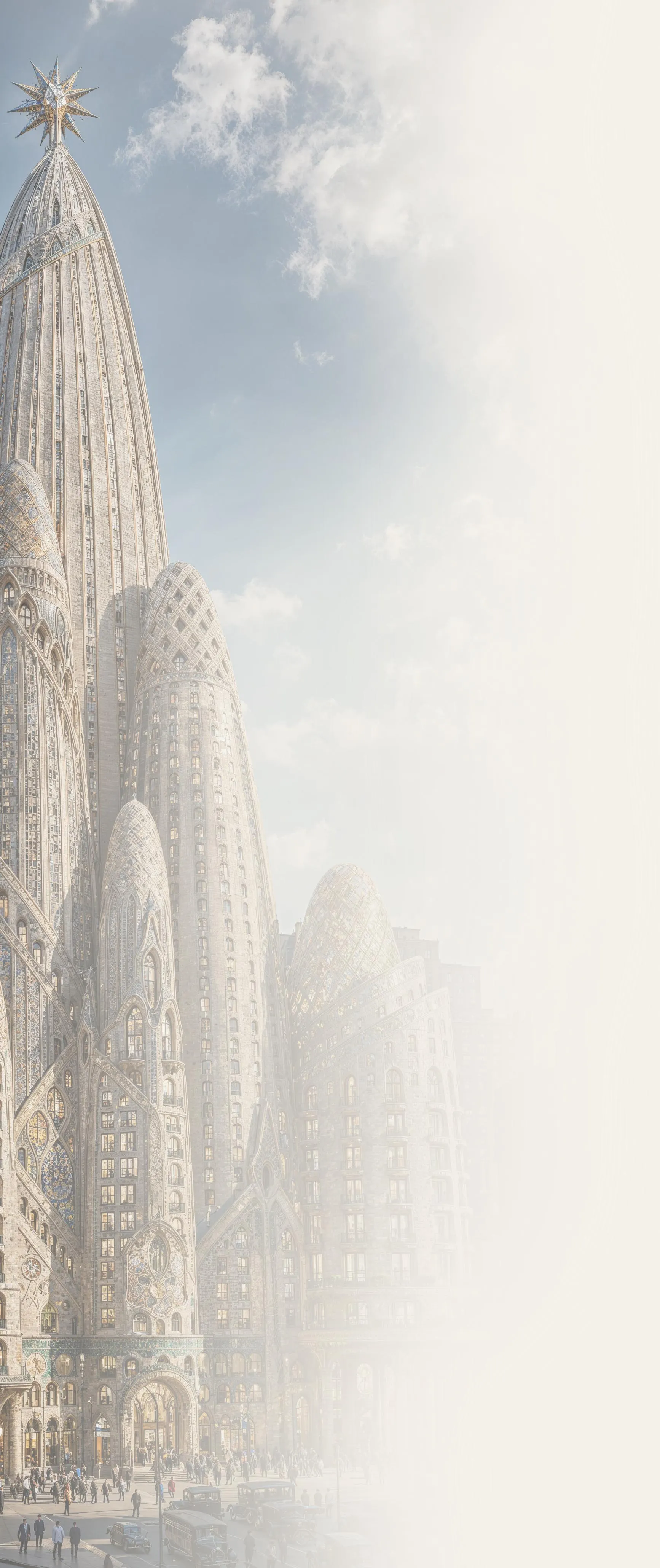
Gaudí’s Hotel Attraction was never built. Saint Lambert’s Cathedral, in Liège, was demolished. For the same reason: they were too much. Too large, too present, too ornate. One remained a project on paper, the other was erased from the city. In both cases, someone decided it had no right to stand.
I put them back.
Not as historical reconstructions. I make credible images of what the world could have held. Saint Lambert’s Cathedral returns among the buses, the cars and the apartment blocks of the square as it is today. Gaudí’s skyscraper rises in Manhattan. I am not trying to show the past, but to make visible a possibility that was prevented.
This work around Gaudí and vanished architecture has been covered by Dezeen, Newsweek, Domus, ARTnews Japan and SO FIGARO.
On the cracks.
The rest of my work follows the same gesture, but at street level. I make houses that do not exist. They are small, low, sometimes crooked, wedged between taller and greyer buildings. The walls are cracked, an air conditioner is rusting, cables run across the façades, bags sit at the foot of the wall. And yet someone took up brushes and covered the front with flowers. Not after repairing the house.
I do not want to erase imperfection in order to let beauty appear. I want both to exist together. These houses speak, at their own scale, of the same thing as the refused or vanished architectures: of what has neither the right size, nor the right line, nor the right authority, and adorns itself anyway. Ornament becomes a form of insistence.
I am still here.
I claim saturated colour, joyful accumulation, generous ornament. Not as naïve decoration, but as a way of opening up the image, of refusing erasure, of recalling that sophistication does not always require restraint.
This maximalism is not always a matter of quantity, nor even of colour. It can also live in a dark image, in a silhouette, in a silent piece of architecture, in a detail that holds too much story to remain merely decorative. What interests me is not excess, but intensity. In Scream of a Dying Evening, a near-bare façade, a red tree and the light of day’s end are enough to bring forth a tension, a silence.
My images finally ask a simple question: who decides what is legitimate, what is beautiful, what has the right to exist fully? They speak to those sometimes accused of being “too much”: too visible, too colourful, too different, too alive.
AI as studio material
I don’t ask it to behave.
A generative model leans towards what it knows best: the most probable forms, the most recognised images, a certain statistical average of the world. My work consists in putting it under tension, pushing it out of that average, multiplying constraints, contradictions, accidents and excesses, until something emerges that would not have shown up on its own.
Artificial intelligence is therefore not a machine tasked with producing a finished image. It is a studio material, on the same footing as photography, graphic design, retouching or staging. That is what Made, not generated means: the image may be generated; the work itself is built.
Biography
Born in Belgium in the late 1960s, I spent three decades composing with images, first as a graphic designer, then as a studio and architecture photographer. There I learned technique, light, composition, and above all the patience of the eye.
For more than ten years I have also worked at a socio-professional integration non-profit in Liège, alongside very different life paths: fragile lives, displaced lives, people judged too far from the norm to be easily given a place.
I don’t want to reduce my artistic work to that experience. But I recognise the same movement in it today: making room for what overflows, for what resists the straight line, for what could have disappeared, for what grows regardless.
A large part of my images explores imaginary architecture and heritage: buildings never built, vanished or transformed, and entirely fictional architectures that seem to belong to a parallel history. My first AI-generated Art Nouveau images, in 2022, sparked debates the following year on the boundary between creation, imaginary heritage and visual truth.
This work has found an unexpected audience: more than 450,000 people follow these explorations on Instagram, where fictional images mingle with the flow of the real, seen, liked, discussed sometimes before they are even understood. That circulation interests me too: the image leaves the studio, meets the world and starts working without me.
For those who bloom in the cracks.
Whether captured, composed or generated, my images are proposals: what if the world could hold more than what it has decided to keep?
Commission a project See my Liège photography →